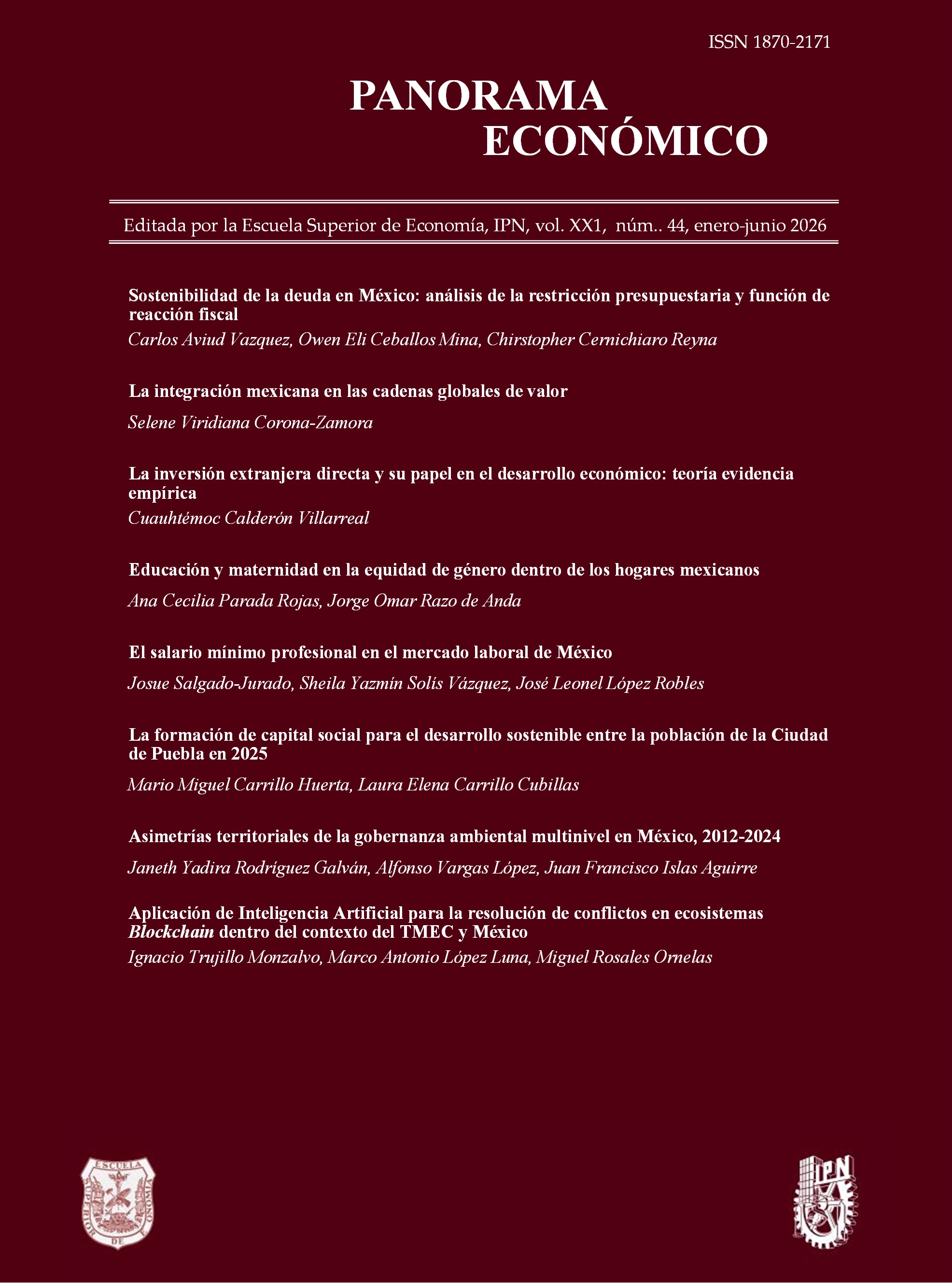
Foreing direct investment and its role in economic development: Theory and empirical evidence
Abstract
This article analyzes the role of foreign direct investment (FDI) in the economic development of peripheral capitalist countries, combining a theoretical review with recent empirical evidence. At the conceptual level, it discusses the contributions of Hymer, Caves, and Kojima, highlighting the dual nature of FDI: on the one hand, a vector for the transfer of capital, technology, and organizational capabilities; on the other, a mechanism of oligopolistic control that may reinforce dependency relations. Empirically, the article examines the procyclical behavior and unequal global distribution of FDI flows, which remain concentrated in developed economies and only marginally directed toward the periphery. It also compares the effects of export-oriented, trade-complementary FDI in Asia (Japanese-type) with the experience of Latin America, where vertically integrated FDI (American-type) predominates and does not consistently promote growth or reduce inequality. The analysis concludes that the developmental impact of FDI depends on national development strategies, institutional quality, and the state’s capacity to channel FDI toward structural transformation.
Keywords
foreing direct investment, multinacional enterprises, economic development, peripheral countries
References
- Aitken, B. J., & Harrison, A. E. (1999). Do domestic firms benefit from direct foreign investment? Evidence from Venezuela. American Economic Review, 89(3), 605–618. https://doi.org/10.1257/aer.89.3.605
- Alfaro, L., Chanda, A., Kalemli-Ozcan, S., & Sayek, S. (2004). FDI and economic growth: The role of local financial markets. Journal of International Economics, 64(1), 89–112. https://doi.org/10.1016/S0022-1996(03)00081-3
- Aminian, N., & Calderón, C. (2010). Prospects for closer economic cooperation in Northeast Asia. Review of Development Economics, 14(3), 417–432. https://doi.org/10.1111/j.1467-9361.2010.00562.x
- Bengoa, M., & Sánchez-Robles, B. (2003). Foreign direct investment, economic freedom and growth: New evidence from Latin America. European Journal of Political Economy, 19(3), 529–545. https://doi.org/10.1016/S0176-2680(03)00011-9
- Blalock, G., & Gertler, P. J. (2008). Welfare gains from foreign direct investment through technology transfer to local suppliers. Journal of International Economics, 74(2), 402–421. https://doi.org/10.1016/j.jinteco.2007.05.011
- Blomström, M., Lipsey, R. E., & Zejan, M. (1994). What explains developing country growth? (NBER Working Paper No. 4132). National Bureau of Economic Research. https://doi.org/10.3386/w4132
- Borensztein, E., De Gregorio, J., & Lee, J.-W. (1998). How does foreign direct investment affect economic growth? Journal of International Economics, 45(1), 115–135. https://doi.org/10.1016/S0022-1996(97)00033-0
- Calderón Villarreal, C. (2011a). Los flujos y la distribución del ingreso en la época del TLCAN. En C. Calderón Villarreal & V. M. Cuevas Ahumada (Coords.), Integración de México en el TLCAN: Sus efectos sobre el crecimiento, la reestructuración productiva y el desarrollo económico (pp. 275–289). Porrúa/UAM.
- Calderón Villarreal, C., & Hernández Bielma, L. (2011b). El TLCAN: Una forma de integración económica dualista: Comercio externo e inversión extranjera directa. Estudios Sociales, 19(1), 91–118.
- Calderón Villarreal, C., & Hernández Bielma, L. (2011c). Perfil de especialización de la inversión extranjera directa en el marco del Tratado de Libre Comercio. En C. Calderón Villarreal & V. M. Cuevas Ahumada (Coords.), Integración de México en el TLCAN: Sus efectos sobre el crecimiento, la reestructuración productiva y el desarrollo económico (pp. 129–146). Porrúa/UAM.
- Calderón-Villarreal, C., & Tykhonenko, A. (2007). Convergencia regional e inversión extranjera directa en México en el contexto del TLCAN, 1994–2002. Investigación Económica, 66(259), 15–42.
- Caves, R. E. (2007). Multinational enterprise and economic analysis (3rd ed.). Cambridge University Press.
- Comisión Económica para América Latina y el Caribe. (2022). La inversión extranjera directa en América Latina y el Caribe 2022. Naciones Unidas.
- Comisión Económica para América Latina y el Caribe, sobre la base de la Conferencia de las Naciones Unidas sobre Comercio y Desarrollo. (2022). World investment report 2022. Naciones Unidas.
- Feenstra, R. C., & Hanson, G. H. (1997). Foreign direct investment and relative wages: Evidence from Mexico's maquiladoras. Journal of International Economics, 42(3–4), 371–393. https://doi.org/10.1016/S0022-1996(96)01475-4
- Financial Times. (2022). fDi Intelligence and fDi Markets. Financial Times Ltd. https://www.fdiintelligence.com
- Financial Times. (2022). fDi Markets database. Financial Times Ltd. https://www.fdimarkets.com
- Ffrench-Davis, R. (1979). Economía internacional: Teorías y políticas para el desarrollo. Fondo de Cultura Económica.
- Ffrench-Davis, R. (1996). Políticas macroeconómicas para el desarrollo. Revista de la CEPAL, 60, 183–198.
- Ffrench-Davis, R., & Reisen, H. (1997). Los flujos de capital y el desempeño de la inversión: Una síntesis. En R. Ffrench-Davis & H. Reisen (Eds.), Flujos de capital e inversión productiva: Lecciones para América Latina (pp. 9–24). McGraw-Hill/OECD.
- Flam, H., & Helpman, E. (1987). Vertical product differentiation and North-South trade. American Economic Review, 77(5), 810–822.
- Gereffi, G., Humphrey, J., & Sturgeon, T. (2005). The governance of global value chains. Review of International Political Economy, 12(1), 78–104. https://doi.org/10.1080/09692290500049805
- Grossman, G. M., & Helpman, E. (1991). Innovation and growth in the global economy. MIT Press.
- Helpman, E. (2006). Trade, FDI, and the organization of firms (NBER Working Paper No. 12091). National Bureau of Economic Research. https://doi.org/10.3386/w12091
- Helpman, E., & Niswonger, B. (2022). Dynamics of markups, concentration and product span. American Economic Journal: Macroeconomics, 14(3), 42–81. https://doi.org/10.1257/mac.20200230
- Hirschman, A. O. (1977). A generalized linkage approach to development, with special reference to staples. En A. O. Hirschman, Essays on economic development and cultural change (pp. 67–98). University of Chicago Press.
- Hymer, S. H. (1960). The international operations of national firms: A study of direct investment (tesis doctoral). Massachusetts Institute of Technology.
- Hymer, S. H. (1970). The efficiency (contradictions) of multinational corporations. American Economic Review, 60(2), 441–448.
- Juárez Rivera, C. G., & Ángeles Castro, G. (2011). Determinantes de la inversión extranjera directa y su impacto en la desigualdad regional en México, 1994–2007. En I. Perrotini Hernández (Coord.), Crecimiento y desarrollo económico en México (pp. 193–220). Benemérita Universidad Autónoma de Puebla.
- Kehrig, M., & Vincent, N. (2019). Good dispersion, bad dispersion (NBER Working Paper No. 25923). National Bureau of Economic Research. https://doi.org/10.3386/w25923
- Kindleberger, C. P. (1990). Les mouvements internationaux de capital. Dunod.
- Kojima, K. (1973). A macroeconomic approach to foreign direct investment. Hitotsubashi Journal of Economics, 14(1), 1–21.
- Kojima, K. (1975). International trade and foreign investment: Substitutes or complements. Hitotsubashi Journal of Economics, 16(1), 1–12.
- Krugman, P. R. (1979). Increasing returns, monopolistic competition, and international trade. Journal of International Economics, 9(4), 469–479. https://doi.org/10.1016/0022-1996(79)90017-5
- Mah, J. S. (2002). The impact of globalization on income distribution: The Korean experience. Applied Economics Letters, 9(15), 1007–1009. https://doi.org/10.1080/13504850210158937
- Milanovic, B. (2002). Can we discern the effect of globalization on income distribution? (World Bank Policy Research Working Paper No. 2876). World Bank. https://doi.org/10.1596/1813-9450-2876
- Nurkse, R. (1960). Problemas de formación de capital en los países insuficientemente desarrollados. Fondo de Cultura Económica.
- Ohlin, B. (1933). Interregional and international trade. Harvard University Press.
- Parenti, M. (2018). Large and small firms in a global market: David vs. Goliath. Journal of International Economics, 110, 103–118. https://doi.org/10.1016/j.jinteco.2017.11.004
- Prebisch, R. (1981). Capitalismo periférico: Crisis y transformación. Fondo de Cultura Económica.
- Shimomura, K.-I., & Thisse, J.-F. (2012). Competition among the big and the small. RAND Journal of Economics, 43(2), 329–347. https://doi.org/10.1111/j.1756-2171.2012.00173.x
- Smith, A. (1979). Investigación sobre la naturaleza y causas de la riqueza de las naciones. Fondo de Cultura Económica.
- Te Velde, D. W. (2003). Foreign direct investment and income inequality in Latin America: Experiences and policy implications. Overseas Development Institute.
- Te Velde, D. W., & Morrissey, O. (2002, abril). Foreign direct investment, skills and wage inequality in East Asia [Ponencia]. DESG Conference, Nottingham, Reino Unido.
- Tsai, P. L. (1995). Foreign direct investment and income inequality: Further evidence. World Development, 23(3), 469–483. https://doi.org/10.1016/0305-750X(95)00136-Z
- United Nations Conference on Trade and Development. (2015). World investment report 2015: Reforming international investment governance. United Nations.
- United Nations Conference on Trade and Development. (2022). UNCTADstat database. https://unctadstat.unctad.org
- United Nations Conference on Trade and Development. (2022). World investment report 2022: International tax reforms and sustainable investment. United Nations. https://unctad.org/publication/world-investment-report-2022
- Vernon, R. (1966). International investment and international trade in the product cycle. Quarterly Journal of Economics, 80(2), 190–207. https://doi.org/10.2307/1880689
- Li, X., & Liu, X. (2005). Foreign direct investment and economic growth: An increasingly endogenous relationship. World Development, 33(3), 393–407. https://doi.org/10.1016/j.worlddev.2004.11.001
- Yeaple, S. R. (2003). The complex integration strategies of multinationals and cross-country dependencies in the structure of foreign direct investment. Journal of International Economics, 60(2), 293–314. https://doi.org/10.1016/S0022-1996(02)00051-X